A website is not the same thing as a business system
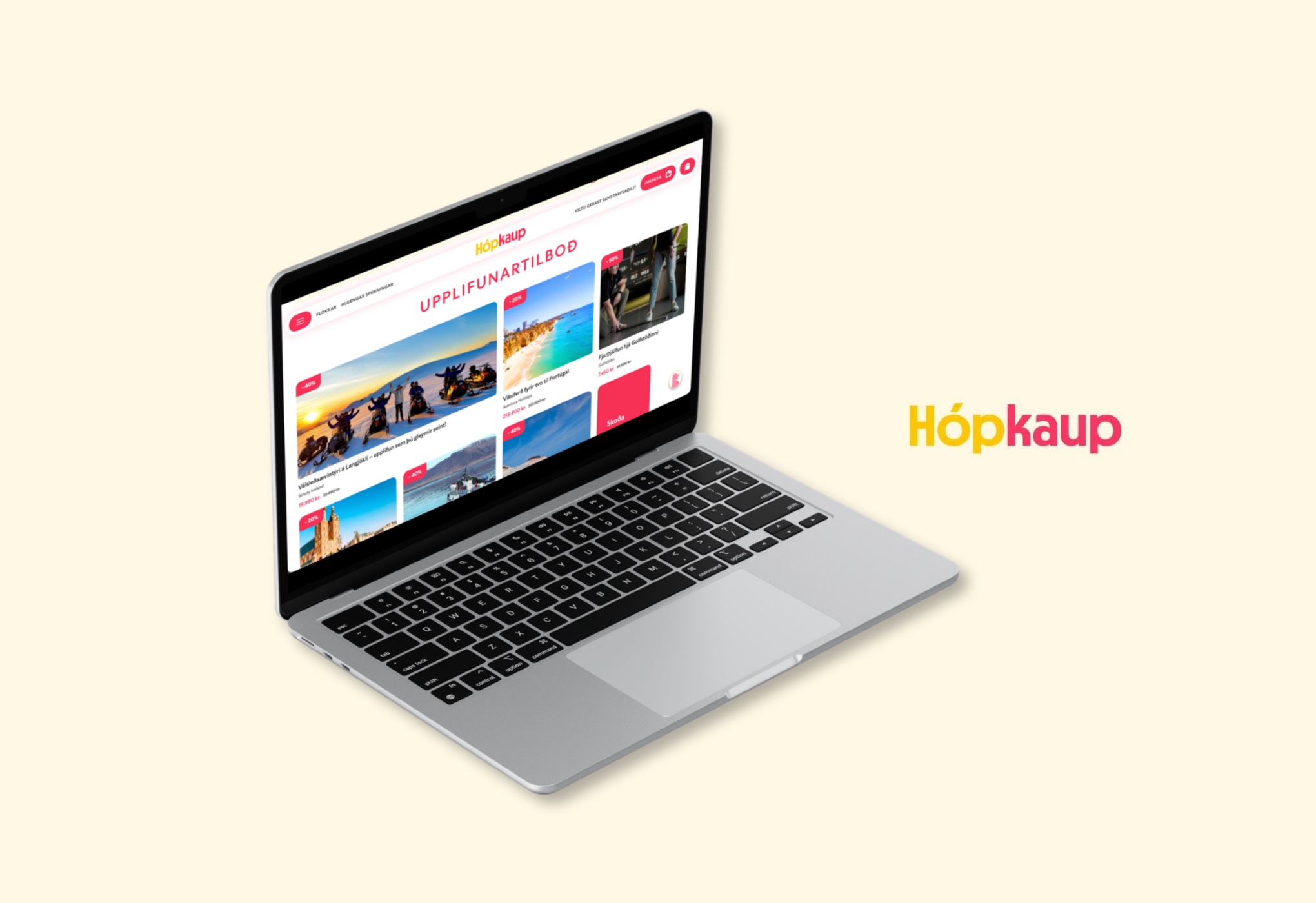
Hópkaup sells deals and offers to Icelandic customers. For a business like that, the website is not a brochure that sits beside the operation — it is the operation. Every offer is published through it, every sale is taken on it, and everything anyone knows about how trading is going comes back through it.
So the brief was not a redesign in the decorative sense. It was to build the system the business runs on: the shop window, the till, the door customers come in through, and the view from the back office — designed together, rather than assembled from whatever tools happened to be to hand.
What we built
The design came first
Discovery, visual identity, then UX and UI
A deals site lives or dies on how quickly an offer can be understood and acted on. The work started with discovery and the visual identity, then the experience itself — what a customer sees first, how an offer is presented, how few steps stand between wanting something and owning it. The interface was designed against that rather than inherited from what was already there.
A storefront built to sell
Next.js at the front, PHP and Nette behind
The storefront is a Next.js application: pages that arrive quickly on an ordinary phone connection, a catalogue that stays fast as it grows, and the search-engine visibility a business depends on when its customers are looking for a specific offer rather than a specific shop. Behind it, a PHP and Nette backend over MySQL holds the catalogue, the orders and the customers, with Redis absorbing the repeated reads so a busy offer does not slow the whole shop down.
Paying, without the detour
Teya checkout, embedded in the flow
Checkout runs through Teya's component, so card details never pass through the site itself and the customer is not handed off to something that looks like somewhere else. Payment stays part of the same page they have been shopping on.
Signing in with what people already have
Google and Facebook
Creating an account is where a lot of carts are lost. Google and Facebook sign-in remove the password step entirely, which matters most for the customer who arrived from a link, found one offer they wanted, and has no intention of filling in a form to get it.
Seeing the business
A BI dashboard, and analytics behind it
We built a BI dashboard so the people running the business can see what is selling and what is not, without commissioning a report to find out. Google Analytics sits alongside it, covering how customers arrive and where they stop, so a decision about the site can answer to behaviour rather than opinion.
One system, not five that nearly fit
Taken separately, none of these is unusual. Taken together they are the whole operating surface of the business — and the value is in their being built as one thing. The storefront, the payment path, the sign-in and the reporting share a single design and a single codebase, so a change in one does not need reconciling with four others, and the numbers in the dashboard are the same numbers the shop is transacting.
That is what a core business system means in practice: the company can run its day on it, and change it when the business changes, without the work turning into an integration project.
Team
- —Mario Miletić
- —Mario Ćosić
- —Bruno Vasilj
- —Ihor Protsiv
- —Dalibor Korpar
Key objectives
Redesign the experience end to end, rather than restyling the site that existed.
Build a storefront the business can sell through every day, quick enough to keep a browsing customer.
Make paying and signing in the least memorable part of the trip.
Give the business its own view of what is selling, without waiting on anyone to produce a report.
Services
- —Visual identity and discovery
- —UX/UI design
- —Web development
- —E-commerce
- —Payments integration
- —Business intelligence
- —Data reports and analysis
- —Project management
Technology
Numbers
80,000+
Customers
5+
Years building and running it together
1st
Group-buying site in Iceland, and the largest