Everyday money, spread across too many apps
Most people's financial life is scattered. The bank app holds the account, a card sits in a wallet, a separate app tracks what the group owes after dinner, loyalty cards live in a drawer, and insurance is bought in a hurry from somewhere else entirely. Each part works. None of them knows about the others.
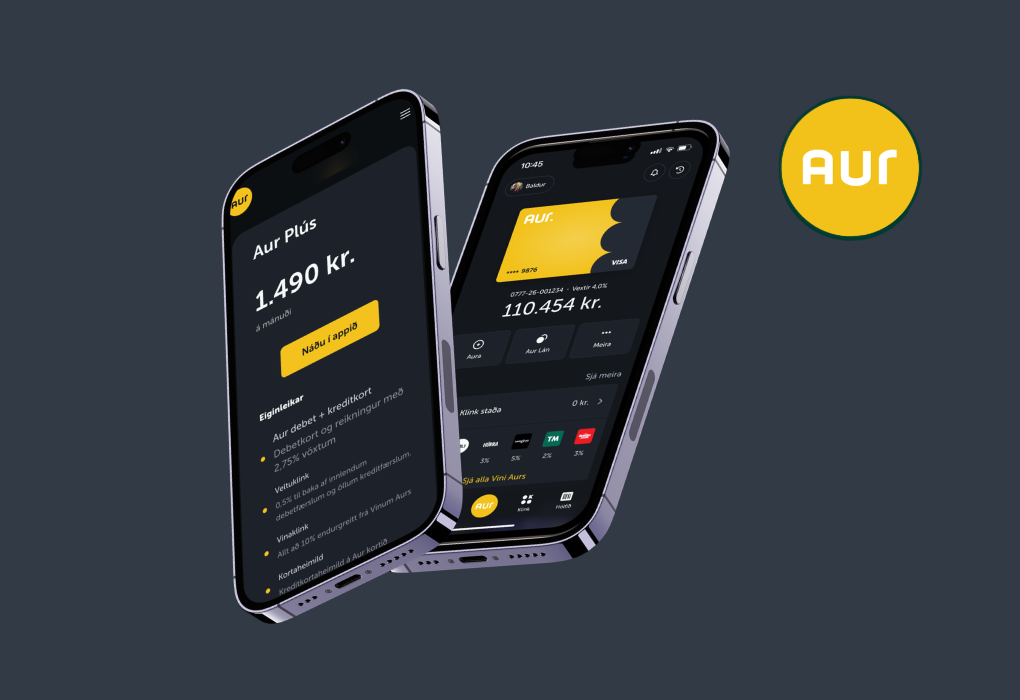
Aur is an Icelandic financial app built on the opposite premise: that the ordinary things people do with money belong in one place, on the device already in their hand. Cards and an account, payments between friends, shared costs, cashback and offers, insurance and short-term credit — one app, secure enough to be trusted with all of it.
What the app does
Cards that pay something back
Debit and credit, in the wallet from day one
A free debit card and a credit card, both usable through Apple Pay and Google Pay as soon as they are issued, with cashback on the spending they carry. The account behind them earns deposit interest rather than sitting idle.
Money between people
Send and request, without leaving the app
Paying someone back is one of the most common things anyone does with money and one of the most awkward to arrange. In Aur it is a transfer between two users rather than an errand involving account numbers.
Splitta, for what a group owes
Shared costs, settled from the transaction history
Group expenses are split and tracked from the transactions that are already there, so the dinner, the trip or the shared flat is reconciled where the money actually moved — the job people otherwise do in a separate app entirely.
Cashback, loyalty and a marketplace
Partner merchants, discounts and bonuses
A rewards programme returns a share of spending at partner merchants, and a marketplace collects the offers and discounts in one place. For the customer it is value on ordinary spending; for the merchant it is a route to an audience already holding the card.
Insurance and short-term credit
Bought where the money already is
Travel insurance is purchased inside the app rather than through a separate provider at the last minute, and short-term loan options sit alongside it. Both are things people go looking for under time pressure, which is exactly when a separate sign-up process fails them.
A marketplace merchants can sell through
The other side of the same platform
Merchants get a straightforward way to put offers in front of Aur's users, which is what keeps the rewards side worth having. The consumer app and the merchant side are two views of one platform rather than two products.
Those capabilities are offered across membership tiers, from a free level that covers splitting, the marketplace, loans and payments, through a free card tier, up to a paid tier adding a credit card, travel insurance and a higher rate of cashback. The tier decides what a member gets; the platform underneath is the same for all of them.
What it runs on
The app is built in Flutter, so iOS and Android come from one codebase and a feature ships to both at once rather than twice on separate schedules. Behind it sit C# and .NET 9 services over PostgreSQL, containerised with Docker and running on AWS.
That shape matters more than usual here. An app holding cards, transfers, credit and insurance is not a product with one integration — it is a product whose surface keeps widening as partners, banks and merchants are added. Keeping the services separable and the deployment repeatable is what makes each of those additions an ordinary piece of work rather than an event.
Where the work is now
Aur is in intensive development rather than maintenance. Current work covers deeper integration with banks and stronger support for merchants, digital loyalty cards to take the last of the plastic out of the drawer, and Aur 2.0 — a new version of the app carrying a complete redesign of the interface along with new capabilities.
The pattern is the one that tends to hold for products people use daily: the feature list grows outward while the thing underneath is rebuilt to carry it, and neither can wait for the other.
A product you stay with
Aur is not something we delivered and handed over. The same team has been with it for years — through new products, new partners and now a full rebuild of the interface — which means a change to the credit flow or the marketplace does not start with somebody working out how the system fits together.
In a financial product that continuity is where the value sits. The expensive work is never the first version; it is everything after. A new bank integration, a change from a card scheme, an obligation that arrives from a regulator, a feature that turns out to need the data model reshaped underneath it — each of those costs a fraction as much to a team that already knows why every earlier decision was made, and a great deal to one meeting the code for the first time.
That is what long-term ownership buys a business: not just a product that works today, but the ability to keep saying yes — to the next partner, the next product, the next version — at a price that does not grow with the age of the codebase.
Team
- —Mirko Budimir
- —Filip Meštrović
- —Jurica Leljak
- —Karlo Dragović
- —Kristijan Babić
Key objectives
Simplify the financial transactions people make every day, on the device already in their hand.
Make paying and being paid fast and secure, inside the app rather than across several.
Bring travel insurance into the same place people already keep their cards.
Give users real value back — cashback, loyalty bonuses and a marketplace of discounts.
Give merchants a straightforward way to sell to that audience.
Services
- —Mobile development
- —Backend and API development
- —Cloud infrastructure
- —Payments integration